Questions & Answers for Patients
❓ What is an upper endoscopy?
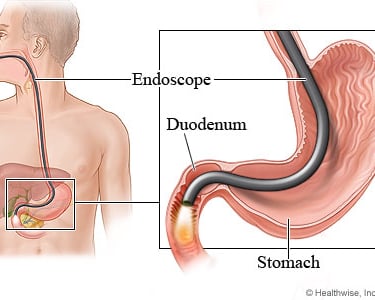
🔍 An upper endoscopy is a test that lets the doctor look inside your throat, food pipe (esophagus), stomach, and first part of the small intestine.
The doctor uses a thin, flexible tube with a tiny camera.
❓ Why do doctors do an upper endoscopy?
🩺 An endoscopy helps doctors find the cause of:
🥴 Trouble swallowing (dysphagia)
🔥 Heartburn and reflux (GERD)
🎯 A mass or growth
🩸 Bleeding
🌾 Celiac disease
❓ How does endoscopy help with trouble swallowing (dysphagia)?
🥪 If food feels stuck, endoscopy can:
Find narrow areas or swelling
Look for scars or strictures
Stretch narrow areas if needed
❓ How does endoscopy help with GERD?
🔥 GERD can cause stomach acid to hurt the esophagus.
Endoscopy helps doctors:
See irritation or sores
Check for damage from acid
Look for conditions like Barrett’s esophagus
❓ What does endoscopy do for a mass or growth?
🎯 Endoscopy can:
Find lumps or bumps
Take a small tissue sample (biopsy)
Help decide the next steps for care
❓ Why is endoscopy used for bleeding?
🩸 Bleeding can cause:
Black stools
Vomiting blood
Low iron and tiredness
Endoscopy helps doctors:
Find where bleeding is coming from
Stop bleeding during the test
❓ How does endoscopy help diagnose Celiac disease?
🌾 Celiac disease is a reaction to gluten.
Endoscopy helps by:
Looking for damage in the small intestine
Taking biopsies to confirm the diagnosis
❓ How do I prepare for an endoscopy?
📋 To get ready:
🚫 Do not eat or drink for several hours
💊 Follow medicine instructions from your doctor
An empty stomach helps the doctor see clearly.
❓ Will the test hurt?
😴 No. You will get medicine to help you relax or sleep.
Most people:
Feel no pain
Remember very little
❓ What happens during the test?
⏱️ The test usually takes 15–30 minutes.
You lie on your side
The camera is gently guided down
The doctor may take biopsies
Treatments can be done if needed
❓ What happens after the test?
🛌 You rest until the medicine wears off.
You may have:
A mild sore throat
Bloating or gas
You will need someone to drive you home.
❓ Are there any risks?
⚠️ Endoscopy is very safe.
Rare risks include:
Bleeding
Tear in the digestive tract
Reaction to medicine
Your doctor will explain these before the test.
❓ When should I call my doctor?
📞 Call if you have:
Severe chest or belly pain
Heavy bleeding
Fever
Trouble swallowing after the test
✅ Key Points to Remember
✔ Endoscopy helps find problems early
✔ Biopsies are quick and painless
✔ Many problems can be treated right away
✔ The test is safe and common
CONTACT US
Admin@austingiclinic.com
Phone:+1 (737) 356 8875
© 2025. All rights reserved. Gastroenterology and Liver clinic of Austin
Gastroenterology and Liver Clinic of Austin is a Professional Association owned by the physicians who practice within it. AGLC’s physicians are directly involved in the management of patient services.
FAX:+1 (737) 290 1567
SITE MAP